
Two differences, with opposite subtraction
Superheat and subcooling compare an actual refrigerant temperature with a saturation reference. Parker’s P–T analysis guide explains the distinction between saturated refrigerant and the vapor or liquid outside that state. Keep both the reference and measured value in your notes; a recorded result of “12 degrees” leaves the next technician guessing which calculation was made.
| Quantity | Calculation | State being described |
|---|---|---|
| Superheat | Actual vapor temperature minus saturation temperature | Vapor above its saturation reference |
| Subcooling | Saturation temperature minus actual liquid temperature | Liquid below its saturation reference |
Use temperatures on the same scale. These results are temperature differences, not the actual temperature of the line. A 10°F difference equals about 5.6 K; converting a difference does not involve adding or subtracting 32.
For blends, use the applicable dew reference for vapor superheat and bubble reference for liquid subcooling. The dew point and bubble point guide explains why a chart can show two saturation temperatures at one pressure. Do not use an average column simply because it is between the other two.
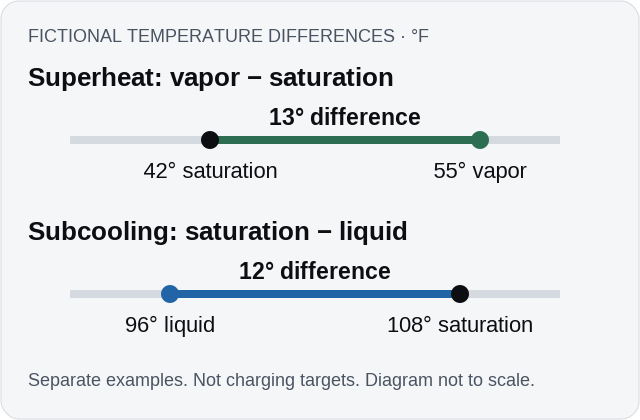
A superheat calculation you can check
This fictional arithmetic example starts with a correctly selected saturation temperature of 42°F and a vapor-line temperature of 55°F, associated with the same measurement location and conditions. The difference is 55 − 42 = 13°F superheat.
A useful note would retain all three values:
Training example: vapor temperature 55°F; corresponding dew saturation temperature 42°F; calculated superheat 13°F. Refrigerant, pressure, location and operating conditions must accompany a real record. These demonstration values are not a charging target.
The pressure-to-temperature conversion is deliberately supplied rather than invented from a pressure table. On a real job, record the refrigerant designation and measured pressure that produced the saturation reference. That makes the conversion traceable if somebody later discovers that the instrument was set to the wrong refrigerant.
A subcooling calculation you can check
In a separate fictional example, the appropriate liquid saturation reference is 108°F and the actual liquid-line temperature is 96°F. Subcooling is 108 − 96 = 12°F.
Reversing the subtraction produces −12°F, which is a calculation error for these stated values. Changing the sign to make a result look normal would hide the mistake. Return to the original readings, identify the correct formula, and retain a corrected calculation with its explanation.
Do not describe this example as a passing result: no specific equipment or manufacturer target has been supplied. “Calculated 12°F” and “within the required target under the specified conditions” are different statements.
What high or low readings can tell you
“High” and “low” only make sense against an applicable reference. A reading outside an equipment target is a reason to investigate under its service procedure; it is not a stand-alone instruction to add refrigerant, remove refrigerant or adjust a valve. A calculation can be arithmetically correct while its pressure, temperature or operating context is wrong.
Before assigning a meaning, review:
- The exact refrigerant selected in the instrument or chart.
- Where the temperature and corresponding pressure were obtained.
- The operating mode, stage and conditions during the readings.
- The manufacturer’s required method and applicable target.
- Any limitation that makes the comparison unreliable.
This reference intentionally keeps high/low questions together rather than offering four separate fault lists that suggest a single number identifies a failed component.
Save the inputs, result and interpretation separately
A practical service record has three layers: inputs, calculation, and interpretation. Inputs preserve what was measured. The calculation shows the subtraction. Interpretation names the equipment specification and conditions used for comparison.
If an input was not recorded, label that gap. Do not reconstruct a plausible pressure later from the result you expected. If readings were taken at different times or locations, preserve those differences rather than presenting the values as one simultaneous set.
Use the pre-measurement context checklist to organize the record, then put the qualified conclusion in the service report. A complete note is more useful than a bare “SH/SC OK.”
Scope of this guide
Conceptual explanation and fictional arithmetic for conventional subcritical refrigeration. Not a charging, gauge-connection, valve-adjustment or fault-diagnosis procedure. Use the equipment manufacturer’s instructions and qualified personnel for physical work.
Sources & editorial notes
Sources checked October 9, 2026. Examples and document layouts are original CoolOps editorial material.
- Parker Sporlan: Using P–T Analysis as a Service Tool
Reference for saturation, superheat and subcooling. Our examples are fictional and are not the publication’s equipment data.
- Danfoss: Refrigerants with high temperature glide
June 2017 technical paper; used for dew/bubble definitions and glide, not retrofit instructions.
These guides are published by the team behind CoolOps. No independent technical review is claimed. How we write and correct our guides.