
What the two columns represent
A blend’s bubble and dew columns describe different boundaries of the liquid–vapor region. At constant pressure, bubble point is where liquid begins to boil; dew point is where the last liquid has evaporated. Moving in the condensation direction reverses the sequence. Danfoss’s discussion of high-glide refrigerants illustrates these boundaries and the temperature change between them.
A chart may label the columns “liquid” and “vapor” instead. Read its legend and refrigerant designation rather than relying on a remembered column position. A screenshot with the heading cropped off is a poor reference, even if its numbers look familiar.
| Question | Reference to identify |
|---|---|
| How far above saturation is this vapor? | Dew / saturated-vapor temperature |
| How far below saturation is this liquid? | Bubble / saturated-liquid temperature |
| What is the difference between the two boundaries at one pressure? | Temperature glide at that pressure |
Glide is a difference at a stated pressure
Temperature glide means a zeotropic blend changes temperature as it changes phase at constant pressure. The glide value must retain its pressure or stated reference condition. Do not treat a rounded number from a product overview as a replacement for the applicable P–T data at every operating point.
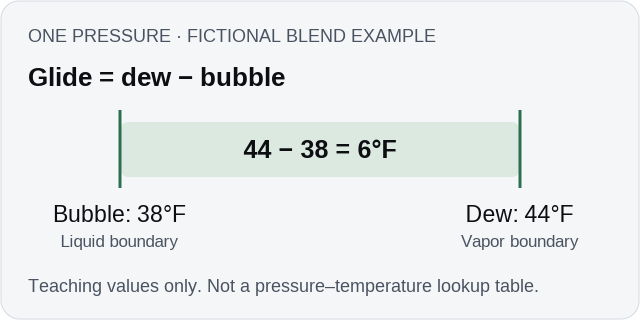
The numbers below are invented to demonstrate the arithmetic, not a pressure table for any named refrigerant:
| Fictional lookup at one pressure | Temperature |
|---|---|
| Bubble boundary | 38°F |
| Dew boundary | 44°F |
| Boundary difference | 6°F |
The 6°F is the difference between those two saturation boundaries. It is not 6°F superheat, 6°F subcooling or an air-side temperature split. Those quantities compare different temperatures.
Why choosing the column changes the answer
Suppose a fictional vapor-temperature reading is 54°F and the appropriate dew reference from the example is 44°F. Superheat is 54 − 44 = 10°F. Using the bubble value instead gives 54 − 38 = 16°F, which answers the wrong question.
For a separate liquid-side illustration, suppose bubble is 104°F, dew is 110°F, and the actual liquid temperature is 94°F. Subcooling is 104 − 94 = 10°F. Selecting dew would incorrectly give 16°F. These are independent teaching examples; they are not paired measurements from an actual system.
Parker’s P–T reference identifies bubble values for subcooling and dew values for superheat. Keep that selection in the record along with the calculation. The superheat/subcooling guide covers the subtraction without prescribing a charging target.
How much glide real refrigerants have
The size of the gap depends on the refrigerant. ASHRAE’s refrigerant fact sheet lists bubble and dew temperatures at the normal boiling point, that is, at atmospheric pressure:
| Refrigerant | Bubble | Dew | Glide |
|---|---|---|---|
| R-454B | −59.6°F | −58.0°F | 1.6°F |
| R-448A | −50.6°F | −39.6°F | 11.0°F |
R-410A sits at the other end: a supplier data sheet lists its glide as 0.1 K, about 0.2°F, at atmospheric pressure. For R-410A the two columns are practically the same number. For a high-glide blend such as R-448A, picking the wrong column changes a superheat or subcooling result by several degrees.
These figures show the scale only. Glide changes with pressure, so a calculation still needs the bubble or dew value at the pressure actually measured.
A lookup check before interpreting a reading
Use this document check when reviewing a measurement that a qualified technician has already taken:
- Confirm the exact refrigerant designation from the equipment record and applicable documentation.
- Confirm the pressure unit and whether the source uses gauge or absolute pressure.
- Identify the column’s definition from the source’s legend.
- Save the source title or instrument setting with the reading.
- Check that pressure and temperature describe the intended location and operating condition.
This is a check of the reference data, not a procedure for attaching instruments or opening the refrigerant circuit. A correct chart lookup cannot compensate for incompatible or unreliable measurements.
Keep three meanings of temperature apart
Refrigerant saturation temperature, measured line temperature and surrounding air temperature belong in separately named fields. Labeling each simply “temp” makes a later review unnecessarily difficult. Use labels such as “dew saturation reference” or “liquid-line temperature,” with units and location.
Humidity instruments also display an air dew point. That value concerns moisture in air; it is not the refrigerant dew column for a pressure reading. A report with both air and refrigerant measurements should name the medium explicitly.
For a reusable note, record: refrigerant; pressure and unit; bubble/dew selection; source; actual temperature and location; calculated difference; equipment target if applicable. If the source or setting is missing, keep the conclusion provisional and explain the missing evidence in the service report.
Scope of this guide
Reading reference data and original arithmetic examples. No refrigerant charging, blend handling, retrofit or component-adjustment instructions. Fictional temperatures are not substitute P–T data.
Sources & editorial notes
Sources checked October 16, 2026. Examples and document layouts are original CoolOps editorial material.
- Danfoss: Refrigerants with high temperature glide
June 2017 technical paper; used for dew/bubble definitions and glide, not retrofit instructions.
- Parker Sporlan: Using P–T Analysis as a Service Tool
Form 10-135, 2013. Reference for saturation, superheat and subcooling; its P–T chart notes say to use bubble point values for subcooling and dew point values for superheat. Our examples are fictional and are not the publication’s equipment data.
- ASHRAE/UNEP fact sheet: Update on new refrigerants designations and safety classifications
October 2026 edition. Source of the R-454B and R-448A bubble and dew temperatures at the normal boiling point.
- Gas Servei: R-410A technical data sheet
Supplier data sheet; lists R-410A as a 50/50 R-32/R-125 blend with a glide of 0.1 K at 1.013 bar.
These guides are published by the team behind CoolOps. No independent technical review is claimed. How we write and correct our guides.